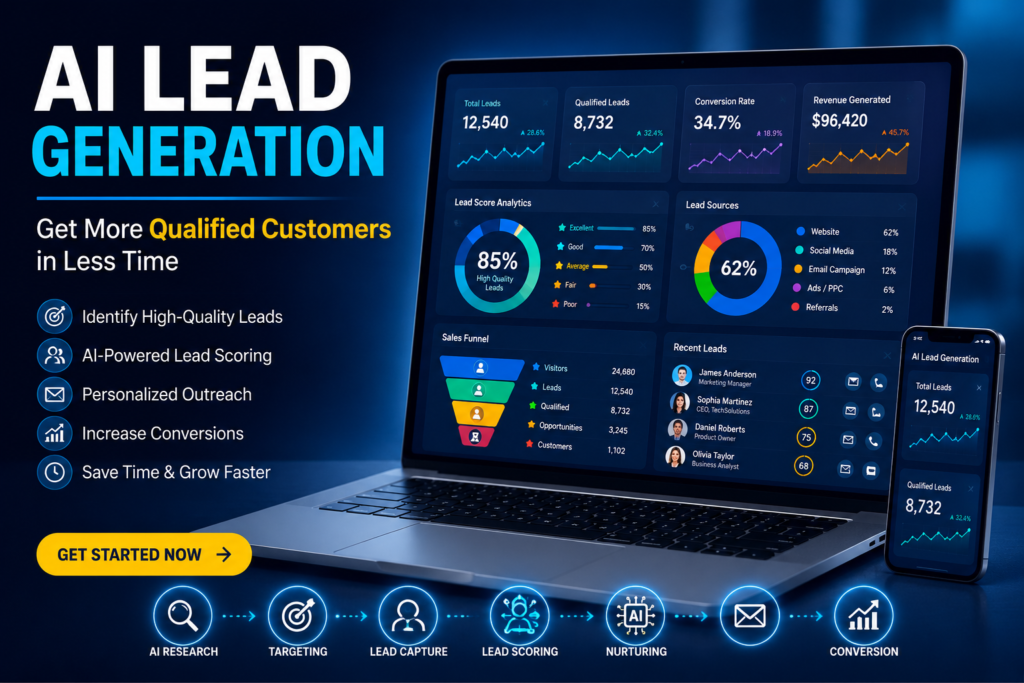
7 Powerful AI Lead Generation Techniques Every Business Should Use
In today’s competitive digital world, businesses need smarter ways to attract and convert potential customers. AI Lead Generation has emerged as one of the most powerful solutions for companies looking to increase sales while reducing manual effort. Instead of spending hours searching for prospects, AI tools can identify, qualify, and nurture leads automatically.
Whether you’re a small business owner, marketer, freelancer, or agency, AI can help you find the right customers faster than traditional methods. In this guide, we’ll explore how AI Lead Generation works, its benefits, strategies, tools, and best practices to help your business grow.
What is AI Lead Generation?
AI Lead Generation is the process of using Artificial Intelligence technologies to identify, attract, qualify, and nurture potential customers automatically.
Traditional lead generation often involves manual research, cold outreach, and lengthy qualification processes. AI streamlines these tasks by analyzing large amounts of customer data, predicting buying behavior, and identifying prospects most likely to convert.
AI-powered systems can:
- Find potential customers online
- Analyze customer behavior
- Score leads automatically
- Personalize marketing campaigns
- Automate follow-ups
- Improve conversion rates
As a result, businesses spend less time chasing unqualified prospects and more time closing deals.
Why AI Lead Generation Matters in 2026
Consumer behavior is changing rapidly. Customers expect personalized experiences, quick responses, and relevant solutions.
Businesses using AI Lead Generation gain a competitive advantage because AI can:
Faster Lead Discovery
AI scans websites, social media platforms, search engines, and databases to identify potential customers within minutes.
Better Lead Qualification
Not every lead is ready to buy. AI evaluates behavior, demographics, engagement levels, and purchase intent to identify high-quality prospects.
Increased Productivity
Sales and marketing teams can focus on closing deals instead of manually searching for leads.
Improved Customer Experience
AI enables personalized communication based on customer interests and behaviors.
Higher Conversion Rates
When businesses target qualified leads, conversion rates naturally improve.
How AI Lead Generation Works
Understanding the process helps businesses maximize results.
1. Data Collection
AI gathers information from multiple sources such as:
- Website visitors
- Social media interactions
- Search behavior
- CRM systems
- Email campaigns
- Online directories
2. Lead Identification
AI analyzes collected data to identify individuals or businesses showing interest in products or services.
3. Lead Scoring
AI assigns scores to leads based on:
- Website activity
- Engagement level
- Demographics
- Purchase intent
- Industry relevance
High-scoring leads receive priority attention.
4. Personalized Engagement
AI sends customized messages through:
- Email marketing
- Chatbots
- Social media outreach
- SMS campaigns
5. Lead Nurturing
Prospects who are not ready to buy immediately continue receiving relevant content until they become sales-ready.
Benefits of AI Lead Generation
Saves Time
Manual prospecting can take hours every day. AI automates repetitive tasks, allowing teams to focus on strategy and sales.
Improves Lead Quality
AI identifies prospects who are genuinely interested in your services, resulting in better quality leads.
Reduces Marketing Costs
Businesses can allocate budgets more efficiently by targeting high-intent audiences.
Enhances Personalization
AI helps deliver relevant content based on customer behavior and preferences.
Supports Scalability
Whether you’re generating 100 leads or 10,000 leads, AI systems can handle growth efficiently.
AI Lead Generation Strategies That Work
Use AI Chatbots
Chatbots engage website visitors instantly and collect valuable information.
Benefits include:
- 24/7 customer support
- Faster responses
- Automated lead capture
- Improved user experience
Popular chatbot tools include:
- ChatGPT
- Drift
- Intercom
- Tidio
Implement Predictive Lead Scoring
Predictive lead scoring uses AI algorithms to determine which leads are most likely to convert.
This helps sales teams prioritize efforts and close deals faster.
Personalize Email Marketing
AI can analyze customer behavior and create highly personalized email campaigns.
Personalized emails often achieve:
- Higher open rates
- Better click-through rates
- Increased conversions
Optimize Landing Pages
AI tools can analyze user behavior and suggest improvements for landing page performance.
Optimization areas include:
- Headlines
- Call-to-action buttons
- Forms
- Content structure
Leverage Social Media Intelligence
AI can identify potential customers based on:
- Interests
- Industry
- Engagement patterns
- Online discussions
This allows businesses to reach targeted audiences more effectively.
Best AI Lead Generation Tools
ChatGPT
ChatGPT helps create personalized messages, email campaigns, social media content, and lead nurturing sequences.
Best for:
- Content creation
- Lead nurturing
- Customer engagement
HubSpot AI
HubSpot offers AI-powered lead scoring, CRM automation, and customer insights.
Best for:
- Marketing automation
- CRM management
- Lead qualification
Apollo.io
Apollo helps businesses find and engage qualified prospects.
Best for:
- B2B lead generation
- Prospect research
- Sales outreach
Clay
Clay combines multiple data sources and AI automation to build prospect lists.
Best for:
- Advanced prospecting
- Data enrichment
- Personalized outreach
Instantly AI
Instantly helps businesses scale cold email campaigns using AI.
Best for:
- Cold outreach
- Email automation
- Lead nurturing
AI Lead Generation for Small Businesses
Many small business owners believe AI is only for large companies. That’s no longer true.
Today, affordable AI tools make lead generation accessible to businesses of all sizes.
Small businesses can use AI to:
- Generate local leads
- Improve customer engagement
- Automate follow-ups
- Manage marketing campaigns
- Increase sales opportunities
For example, a local digital marketing agency can use AI to identify businesses that need SEO services and automatically initiate outreach campaigns.
Common Mistakes to Avoid
Relying Only on Automation
AI is powerful, but human relationships still matter. Combine automation with genuine communication.
Ignoring Data Quality
Poor data leads to poor results. Ensure customer information remains accurate and updated.
Over-Personalization
While personalization is beneficial, excessive personalization can appear intrusive.
Not Tracking Performance
Monitor important metrics such as:
- Lead quality
- Conversion rates
- Cost per lead
- Customer acquisition cost
Regular analysis helps optimize campaigns.
Future of AI Lead Generation
The future of lead generation will become increasingly intelligent.
Emerging trends include:
Hyper-Personalization
AI will deliver highly customized customer experiences based on real-time behavior.
Advanced Predictive Analytics
Businesses will identify buying intent before prospects actively search for solutions.
Voice and Conversational AI
Voice assistants and AI agents will become important lead generation channels.
Real-Time Customer Insights
AI systems will continuously monitor customer behavior and recommend actions instantly.
Businesses that adopt AI early will gain a significant competitive advantage.
How to Start Using AI Lead Generation Today
If you’re new to AI, start with these simple steps:
Step 1: Define Your Ideal Customer
Understand who your target audience is.
Step 2: Choose an AI Tool
Select tools that match your business goals and budget.
Step 3: Automate Lead Capture
Implement chatbots, forms, and CRM integrations.
Step 4: Score and Segment Leads
Use AI to prioritize high-value prospects.
Step 5: Personalize Communication
Create relevant content and outreach campaigns.
Step 6: Measure Results
Track conversions and continuously optimize your strategy.
Conclusion
AI Lead Generation is transforming the way businesses attract and convert customers. By automating prospecting, lead qualification, and customer engagement, AI helps organizations generate more qualified leads in less time.
Whether you’re a freelancer, startup, digital marketing agency, or established business, implementing AI lead generation strategies can significantly improve efficiency, reduce costs, and increase sales.
The businesses that embrace AI today will be better positioned to compete, grow, and succeed in the future. If your goal is to generate more qualified customers while saving time, AI Lead Generation is no longer optional—it’s essential.
AI Budget vs Traditional Budget: Which Delivers Better ROI?
As businesses compete for customer attention in an increasingly digital marketplace, marketing budgets have become more important than ever. Companies must decide where to invest their resources to generate the highest return. This is where AI Lead Generation is transforming the marketing landscape.
Traditional marketing methods often require significant investments in advertising, manpower, and time. On the other hand, AI-powered marketing solutions automate lead generation, improve targeting accuracy, and reduce wasted spending. Understanding the differences between AI-driven and traditional marketing budgets can help businesses make smarter financial decisions.
Understanding Traditional Marketing Budgets
Traditional marketing typically includes:
- Print advertising
- Newspaper and magazine ads
- Radio advertisements
- Television commercials
- Billboards
- Cold calling
- Direct mail campaigns
- Trade shows and events
While these methods can still be effective in certain industries, they often involve substantial upfront costs and limited tracking capabilities.
Typical Traditional Marketing Expenses
Businesses investing in traditional marketing often allocate budgets toward:
Advertising Costs
TV, radio, and print advertisements can consume a large portion of the budget.
Staff and Sales Teams
Traditional lead generation usually requires dedicated sales representatives to identify, contact, and qualify prospects.
Event Participation
Trade shows and networking events involve booth fees, travel expenses, accommodation, and promotional materials.
Printing and Distribution
Brochures, flyers, catalogs, and direct mail campaigns add recurring expenses.
These costs can quickly accumulate, especially for small and medium-sized businesses.
What is an AI Marketing Budget?
An AI marketing budget focuses on technologies that automate and optimize customer acquisition.
Common AI-related investments include:
- AI Lead Generation tools
- CRM automation software
- AI chatbots
- Email marketing automation
- Predictive analytics platforms
- Customer data platforms
- AI content creation tools
Unlike traditional marketing, AI solutions continuously improve performance through data analysis and machine learning.
Cost Comparison: AI vs Traditional Marketing
One of the biggest advantages of AI Lead Generation is cost efficiency.
Traditional Marketing Costs
Traditional campaigns often involve:
| Expense Category | Monthly Cost |
|---|---|
| Newspaper Ads | $500 – $5,000 |
| Radio Advertising | $1,000 – $10,000 |
| Cold Calling Team | $2,000 – $20,000 |
| Trade Shows | $5,000 – $50,000 |
| Print Materials | $500 – $5,000 |
These costs can become difficult to sustain, especially if campaigns do not produce consistent results.
AI Marketing Costs
AI solutions are generally more scalable and predictable.
| Expense Category | Monthly Cost |
|---|---|
| AI Lead Generation Software | $50 – $1,000 |
| CRM Automation | $20 – $500 |
| AI Chatbots | $30 – $500 |
| Email Automation | $15 – $300 |
| Analytics Tools | $20 – $500 |
Businesses can often achieve better results while spending significantly less.
AI Lead Generation Reduces Customer Acquisition Costs
Customer Acquisition Cost (CAC) is one of the most important marketing metrics.
Traditional marketing often targets broad audiences, resulting in wasted spending on individuals who may never become customers.
AI Lead Generation reduces acquisition costs by:
- Identifying high-intent prospects
- Eliminating unqualified leads
- Improving audience targeting
- Automating repetitive tasks
- Increasing conversion rates
When businesses focus only on qualified leads, they spend less money acquiring each customer.
Better Targeting Means Better Budget Allocation
Traditional campaigns often rely on assumptions about customer behavior.
For example:
- A billboard targets everyone who drives past it.
- A newspaper ad reaches all readers regardless of interest.
- A radio ad reaches a broad audience.
In contrast, AI Lead Generation uses real customer data to target people who are actively interested in specific products or services.
AI analyzes:
- Search behavior
- Website visits
- Social media engagement
- Purchase history
- Demographic data
This precision ensures marketing budgets are spent on the right audience.
AI Eliminates Wasted Marketing Spend
One of the biggest challenges in traditional marketing is waste.
Businesses frequently spend money on:
- Unqualified prospects
- Poor-performing advertisements
- Ineffective sales outreach
- Broad audience targeting
AI continuously monitors campaign performance and adjusts strategies in real time.
For example:
If an ad campaign is generating low-quality leads, AI can automatically optimize targeting, messaging, or budget allocation.
This results in higher efficiency and lower costs.
Productivity Comparison
Traditional Marketing Productivity
A salesperson may spend:
- 3 hours researching prospects
- 2 hours sending emails
- 1 hour following up
- Additional hours qualifying leads
Much of this work is repetitive and time-consuming.
AI Marketing Productivity
With AI Lead Generation, software can:
- Research prospects automatically
- Score leads instantly
- Send personalized emails
- Schedule follow-ups
- Track customer interactions
Tasks that previously required hours can now be completed in minutes.
Conversion Rate Comparison
Marketing budgets should not only focus on lead volume but also lead quality.
Traditional marketing often generates:
- Higher lead volume
- Lower lead quality
- Lower conversion rates
AI-powered marketing generally produces:
- More qualified leads
- Better customer matching
- Higher conversion rates
Because AI Lead Generation focuses on customer intent and behavior, businesses often experience significant improvements in sales performance.
Long-Term ROI: AI vs Traditional Marketing
Return on Investment (ROI) is ultimately what matters most.
Traditional Marketing ROI Challenges
Traditional campaigns often struggle with:
- Limited tracking
- Broad targeting
- High operational costs
- Slow optimization
As a result, businesses may not know which channels are delivering the best results.
AI Marketing ROI Advantages
AI provides:
- Real-time performance tracking
- Predictive analytics
- Automated optimization
- Detailed customer insights
These capabilities help businesses maximize returns while minimizing costs.
Why Small Businesses Prefer AI Lead Generation
Small businesses often have limited marketing budgets.
Hiring large sales teams or investing in expensive advertising campaigns may not be realistic.
AI Lead Generation offers an affordable alternative by providing:
- Automated lead discovery
- Smart customer targeting
- Scalable growth
- Lower acquisition costs
- Faster results
This makes AI particularly attractive for startups, freelancers, digital marketing agencies, and local businesses.
The Future of Marketing Budgets
The future is increasingly data-driven.
Companies are shifting budgets from traditional marketing toward:
- Artificial Intelligence
- Marketing Automation
- Predictive Analytics
- Customer Intelligence Platforms
As AI technology becomes more advanced, businesses that adopt these tools early will likely gain a significant competitive advantage.
Conclusion
When comparing marketing budgets, AI Lead Generation consistently delivers better efficiency, lower costs, and higher returns than many traditional marketing methods. While traditional advertising still has value in certain situations, AI enables businesses to target qualified prospects, automate workflows, and optimize spending with unmatched precision.
For companies looking to maximize ROI, reduce customer acquisition costs, and scale growth efficiently, investing in AI Lead Generation is becoming one of the smartest marketing decisions available today
H2: AI Lead Generation in India Forecast (2026–2030)
India is rapidly becoming one of the fastest-growing markets for Artificial Intelligence adoption. As businesses increasingly shift toward digital marketing, AI Lead Generation is expected to play a major role in customer acquisition strategies over the next five years.
According to industry reports, India’s AI market is projected to grow at a CAGR of over 25% annually, driven by increased internet penetration, digital transformation initiatives, and growing demand for marketing automation. As a result, AI Lead Generation solutions are expected to become a standard tool for businesses of all sizes.
Why AI Lead Generation is Growing in India
Several factors are contributing to the rise of AI Lead Generation in India:
Increasing Digital Adoption
More than 900 million internet users are expected in India by 2030. Businesses are investing heavily in digital channels to reach online consumers.
Growth of Small Businesses and Startups
India has one of the world’s largest startup ecosystems. Startups are increasingly adopting AI tools to generate leads efficiently without hiring large sales teams.
Affordable AI Tools
The availability of low-cost AI platforms makes advanced lead generation accessible even to small and medium-sized businesses.
Rising Competition
Businesses are looking for smarter ways to identify and engage potential customers. AI Lead Generation helps companies stay competitive by improving lead quality and conversion rates.
Market Forecast for AI Lead Generation in India
2026
- Increased adoption among digital marketing agencies
- Growing use of AI chatbots and CRM automation
- More businesses investing in automated lead nurturing
2027
- Predictive lead scoring becomes mainstream
- AI-powered customer behavior analysis expands
- Higher demand for personalized marketing campaigns
2028
- Over 50% of mid-sized businesses expected to use AI-driven lead generation tools
- Integration of AI with WhatsApp Marketing and Social Media Marketing
- Improved automation across sales funnels
2029
- Advanced conversational AI becomes common
- Real-time lead qualification systems widely adopted
- Significant reduction in manual prospecting
2030
- AI Lead Generation expected to become a standard marketing practice
- Businesses relying heavily on predictive analytics for customer acquisition
- AI-powered sales automation driving higher ROI across industries
Industries Expected to Benefit Most
The following sectors are expected to see rapid growth in AI Lead Generation adoption:
- Digital Marketing Agencies
- Real Estate
- Healthcare
- Education & EdTech
- Financial Services
- E-commerce
- SaaS Companies
- Local Service Businesses
- Recruitment Agencies
- Travel & Hospitality
Expected Benefits for Indian Businesses
Businesses using AI Lead Generation can expect:
- Lower customer acquisition costs
- Faster lead qualification
- Better conversion rates
- Improved customer targeting
- Increased marketing ROI
- Scalable growth opportunities
Conclusion
The future of AI Lead Generation in India looks extremely promising. As AI technology becomes more affordable and accessible, businesses that adopt AI-driven lead generation early will gain a strong competitive advantage. By 2030, AI is expected to transform how Indian businesses attract, nurture, and convert customers, making AI Lead Generation one of the most important digital marketing trends of the decade.
Suggested for SEO
AI Lead Generation in India Forecast 2026–2030: Market Growth, Trends & Opportunities
This section can be added directly before your blog’s conclusion to strengthen SEO relevance for Indian search traffic.